Customer Success Was Built to Settle an Argument
Before we argue about whether AI kills customer success, it's worth knowing what the first customer success team was actually for. It wasn't the leaky bucket. Part 1 of 3.
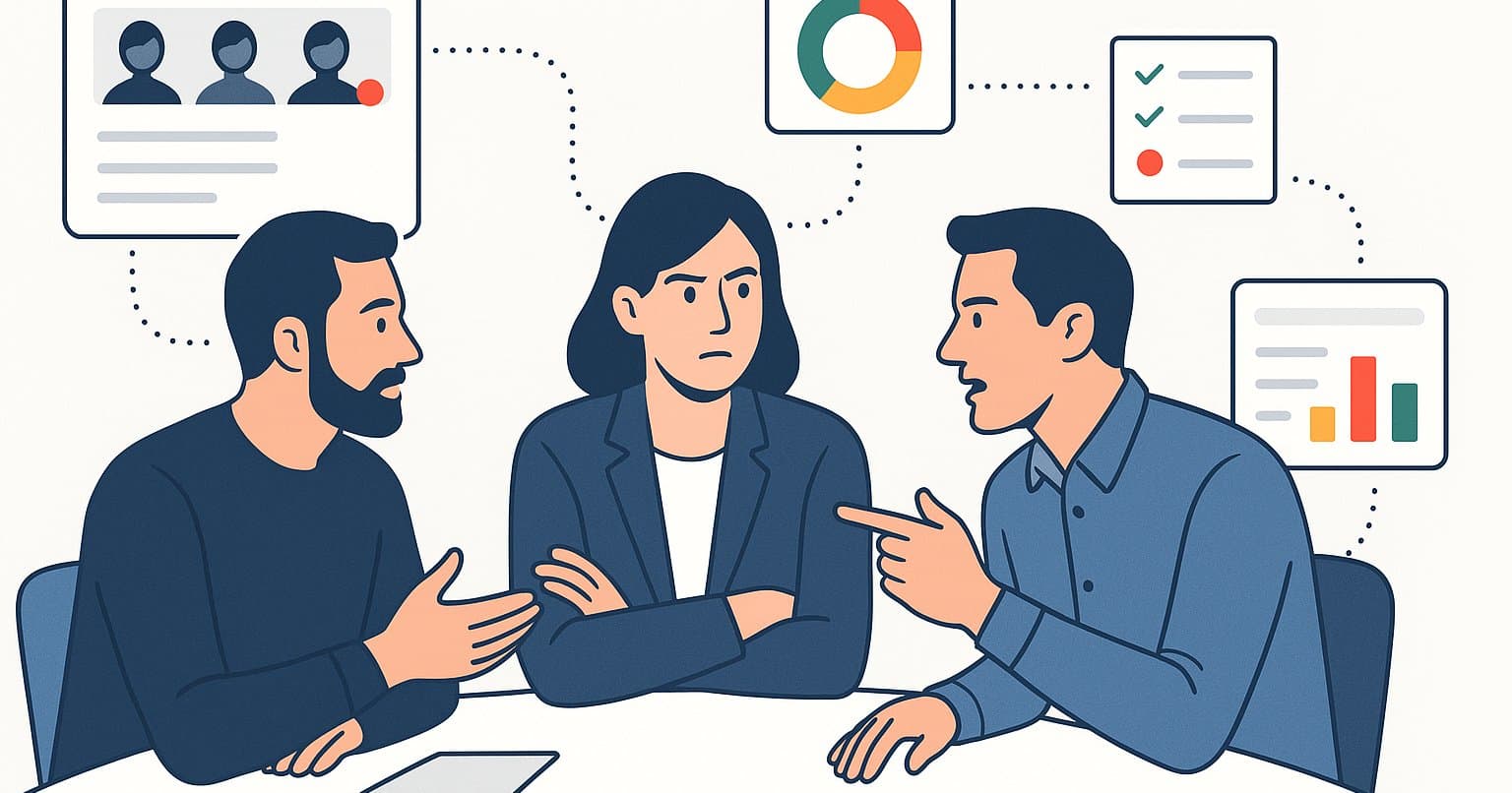
Every “AI is killing customer success” post you’ll read this year is about a department. That’s the wrong unit. The first customer success team was built in 1996 to settle an argument about who owns the customer after the contract is signed, and the woman who built it has said on the record that churn had nothing to do with it. Thirty years later the argument is open again. This time the product is one of the parties.
This series runs in three pieces. This one is about where customer success came from and what it was hired to own. The second will make the case that AI and the product are taking that job back. The third will make the case that they can’t. I’m not going to tell you which one I believe, because I’m still working on this idea, and I’d rather you argue with me than agree.
The gap that gets a person’s name on it
Customer success is what companies invent when a handoff keeps failing.
I watched it happen at ShoreTel starting in 2010. ShoreTel sold phone systems, and with them support contracts, and I was in the technical assistance center. The recurring failure had nothing to do with skill. A customer would call in, get a rep, explain the problem, and by the third call be explaining it to a third person who had read the notes and still didn’t understand the environment. Every miss cost trust, and every big account had a threshold of misses before someone senior got a call.
The fix was a named rep for the accounts that mattered most or hurt the most. Because the job was technical, we called it a technical account manager, a TAM. And in the beginning it was free. Nobody priced it, because it wasn’t a product. It was the thing you did so the top customers renewed their support contracts and bought the next round of hardware. Three years later I left to build a customer success program at Pivot3 for a hardware-as-a-service model, and when I came back to ShoreTel it was to build out the TAM organization and turn it into a profit center. My first title with the words “customer success” in it came in 2015, five years after the problem it was named for.
In practice, there’s real difficulty in seeing the pattern while you’re inside it. Your named-rep program feels like a local fix for a local problem. Then you look up and realize every recurring-revenue business of that decade was inventing the same job, giving it slightly different names, and fighting the same fight over which department got to keep it.
What Vantive was arguing about in 1996
The popular origin story goes like this: Salesforce invented customer success in 2005 because SaaS churn was drowning the company. I told that story for years. It’s mostly wrong, and the correction is more useful than the myth.
The first named customer success department was at Vantive, a CRM vendor, in 1996 and 1997. Marie Alexander built it from the services side of the company, and she has been blunt about why: “A few articles have incorrectly reported that we had a churn problem, which was the impetus to create this program. Nothing could have been further from the truth.” The real cause was a fight. In her words, “the specific customer success manager position resulted from a heated debate on account management and where the responsibility belonged.”
Two things about her version matter for everything that comes after. Her CSMs were “compensated for a customer’s success, not our revenue.” And her own summary of what she’d built: “Customer Success was not a department for us. It was a culture. It was an attitude. It was a corporate goal.” By her account the accounts with an assigned CSM grew revenue 300%, and Vantive sold to PeopleSoft for about $433 million at the end of 1999. So the first customer success team was a services function, paid on outcomes, created because sales and services couldn’t agree who owned the customer after signature. Churn wasn’t in the room.
Siebel ran the same play in 2004, when Bruce Cleveland took over its on-demand business and found, per the Customer Success Association’s history, that “there was no one specifically responsible for retaining and expanding the customer relationships post-sale.” Then came Salesforce in 2005, and the number everyone remembers.
The 8% that became a founding myth
The Salesforce story comes from the 2016 book Customer Success by Nick Mehta, Dan Steinman, and Lincoln Murphy, the closest thing the profession has to a founding text. In the spring of 2005, David Dempsey stood up at an executive offsite and presented the churn numbers. As the book puts it: “The churn rate at Salesforce was 8 percent. That doesn’t sound so bad until you add these two words: per month!” The authors call it a “death spiral,” call Dempsey by the nickname that stuck, Dr. Doom, and write that he “had effectively given birth to the customer success movement.”
Eight percent a month compounds to roughly 63% a year. That figure has never appeared in a Salesforce filing. The same chapter says bookings grew 88% that year, so churn never exceeded new business. Slow the growth down and you get a death spiral, which is the projection Dempsey was presenting. The number is lore, retold by the people who built the category, and it did its job: it gave a movement a villain.
What the group Salesforce created did next is the part people forget. It was called Customers for Life, and it was chartered around user adoption. Renewals, upsells, and cross-sells were somebody else’s job. Three origin stories. In two of them the new team was explicitly kept away from revenue, and in all three it was created to do the proactive half of a job nobody owned. Keep that in mind, because by 2024 the arrangement had flipped.
Three things called customer success, and only one of them can be reorganized
Part of why “is customer success dead?” is a bad question is that the founders never agreed on what the words meant.
Murphy’s definition, from 2014, is the cleanest: “Customer Success is when your customers achieve their Desired Outcome through their interactions with your company.” No department in that sentence. He has been explicit that sales is inside it: “Sales is part of Customer Success. Like it or not.” The Customer Success Association defines it as a business strategy, “an integration of functions and activities of Marketing, Sales, Professional Services, Training, and Support.” Also no department.
The Gainsight book splits the difference and, to its credit, says so. Customer success, it argues, is “three different, but closely related, concepts: an organization, a discipline, a philosophy.” The tenth of its Ten Laws is that customer success is “a top-down, company-wide commitment.” Read those together and the book’s own position is that the org chart box is the least important of the three.
So when someone says AI will kill customer success, the first question back is which one. A reorg can kill the organization. A better product can absorb the discipline. Nothing kills the philosophy except a company deciding it doesn’t care whether customers get what they paid for, and that company has a shorter problem than AI.
How the proactive half picked up a quota
Gainsight put about 300 people in a room in San Francisco in May 2013 for the first Pulse. By 2017 it was 4,000. A 2019 study using LinkedIn data found the customer success manager role had grown 736% since 2015. Mehta has estimated the population went from roughly 500 CSMs in 2013 to about 250,000 by 2022. That much headcount needs a budget line, and a budget line needs a justification, and I was in the rooms where the justification got negotiated.
At more than one company where I helped build the function, customer success started in cost of goods sold, next to support. Getting out of COGS was a fight, and the price of winning it was owning revenue, or at least sourcing leads. It gave the department a metric finance would accept, it made “success” comparable from one company to the next, and it let a CS leader walk into a budget meeting with something other than a satisfaction score. Right call, at the time. The cost only showed up later.
By 2024 the survey numbers describe a sales team with a different name. G2 found 67% of customer success executives carry a sales quota and 53% describe their job as primarily a sales role. ChurnZero’s 2024 study had 33% of CS teams reporting to the chief revenue officer, up from 24% a year earlier, with 51% compensated on renewals. Jason Lemkin has been calling this “weaponized” customer success since late 2023, and he’s right about the mechanism: once CS reports to the CRO, the QBR becomes an upsell meeting. He also wrote this spring that customer success “was built to be reactive and relationship-driven.” He’s describing what it became, accurately. It’s the opposite of what Vantive and Salesforce built it to be, and the fact that the sentence reads as obviously true is the best evidence I have for how far the definition drifted.
I’ll put my own position on the table, since I helped make the trade. It was right then, and it’s situational now. Everyone sells. A customer success organization that exists today has to help retain the customer and create the expansion opportunity, whether it takes that opportunity to close or hands it to a seller. Where I’ve changed my mind is on whether that job needs a department to hold it, and that’s the question the next two pieces are about.
Two of the Ten Laws predicted this argument in 2016
Go back to the founding text and it’s already arguing with itself. Law 5 is “You Can No Longer Build Loyalty through Personal Relationships.” Law 6 is “Product Is Your Only Scalable Differentiator.” Those are the two load-bearing claims of every “the product owns the relationship now” argument you’ll read in 2026, published ten years ago by a team where two of the three authors ran Gainsight, the company that sells customer success software. Law 4, “Relentlessly Monitor and Manage Customer Health,” reads today like the job description for the AI agent the CS platforms ship. The category’s founders wrote down the case for its own automation before the category had a name.
What the book couldn’t see in 2016 was a product good enough to act on those laws by itself. That’s what changed. It’s where part 2 starts.
60% of the job is the same everywhere
I wrote a long time ago that about 60% of customer success is the same at every company and 40% is specific to the business, the product, and the buyer. The split still holds, and it’s the split that matters for the AI question.
The 60% is the part everyone recognizes: onboarding, adoption, health, renewal, expansion. It’s also the part that’s easiest to describe as a workflow, which means it’s the part a product or an agent can plausibly take. The 40% is the messy part. Which of your buyers needs a human in the room and which one resents it. Where in your product the value actually shows up, and how long it takes. What “success” means to a customer in a regulated industry versus a startup on a credit card. Joining the two halves so the customer ramps fast, expands, and doesn’t churn before you’ve earned back what it cost to acquire them was the whole job. CAC payback, hopefully by a wide multiple, was the scoreboard underneath every other metric.
Where this gets tricky is that the 40% is the argument for having a department, and it’s also the argument against one. If the specific part is where the value lives, it belongs to the people who know the buyer and the product best, and at most companies that’s not one team.
Where I could be wrong about this
Alexander’s account is one person’s memory of a program from 1996, and the 300% figure is hers. The Salesforce number is lore, and I’ve said so, but lore that three of the field’s founding voices put in print carries weight I shouldn’t dismiss. And the survey numbers on quota-carrying CS come from vendors who sell to CS leaders, which shapes who answers. The direction of all of it is consistent. The precision is not, and if you have a primary source on any of it, I want it.
The questions I’m carrying into part 2
This piece is a debate opener, so I’ll end with the questions I don’t have answers to, and I’d like yours.
If the first customer success team wasn’t built to stop churn, what was it built to stop or grow, and does your company still have that problem?
When you say “customer success,” which of the three do you mean: the organization, the discipline, or the philosophy?
Customer success was carved out of support to be the proactive half of the job. At your company, when did it become the renewal team, and who noticed?
Part 2 makes the case that the product and the whole company are taking the job back. Bring your counterexamples.
Frequently Asked Questions
When was the first customer success team created?
The first named customer success department was built at Vantive, a CRM vendor, in 1996-1997 by Marie Alexander. It preceded Salesforce's 2005 initiative by nine years.
Why did Vantive create the first customer success team?
Marie Alexander built it to settle a heated internal debate over account management responsibility post-sale. Churn was not the driver; the team was compensated on customer outcomes, not company revenue.
Is the Salesforce 8% monthly churn story accurate?
The 8% monthly churn figure is founding lore, never appearing in Salesforce filings. It was a projection of death spiral risk, not actual churn, and became the movement's origin myth.
What did Salesforce's customer success team actually own?
Customers for Life focused solely on user adoption. Renewals, upsells, and cross-sells belonged to other departments. Revenue ownership came later as the function scaled.
How does this history matter for the AI debate?
Understanding customer success's actual origins—ownership disputes, not churn—reframes current AI discussions. The function's core purpose extends beyond what AI or products can automatically replace.