If You Ripped AI Out Tomorrow, What Would Break?
Nate Nasralla's kill-switch question sorts GTM teams into two piles in about ten seconds. Most land in the wrong one. Here are the five answers you can get back, and what each one tells you to do next.
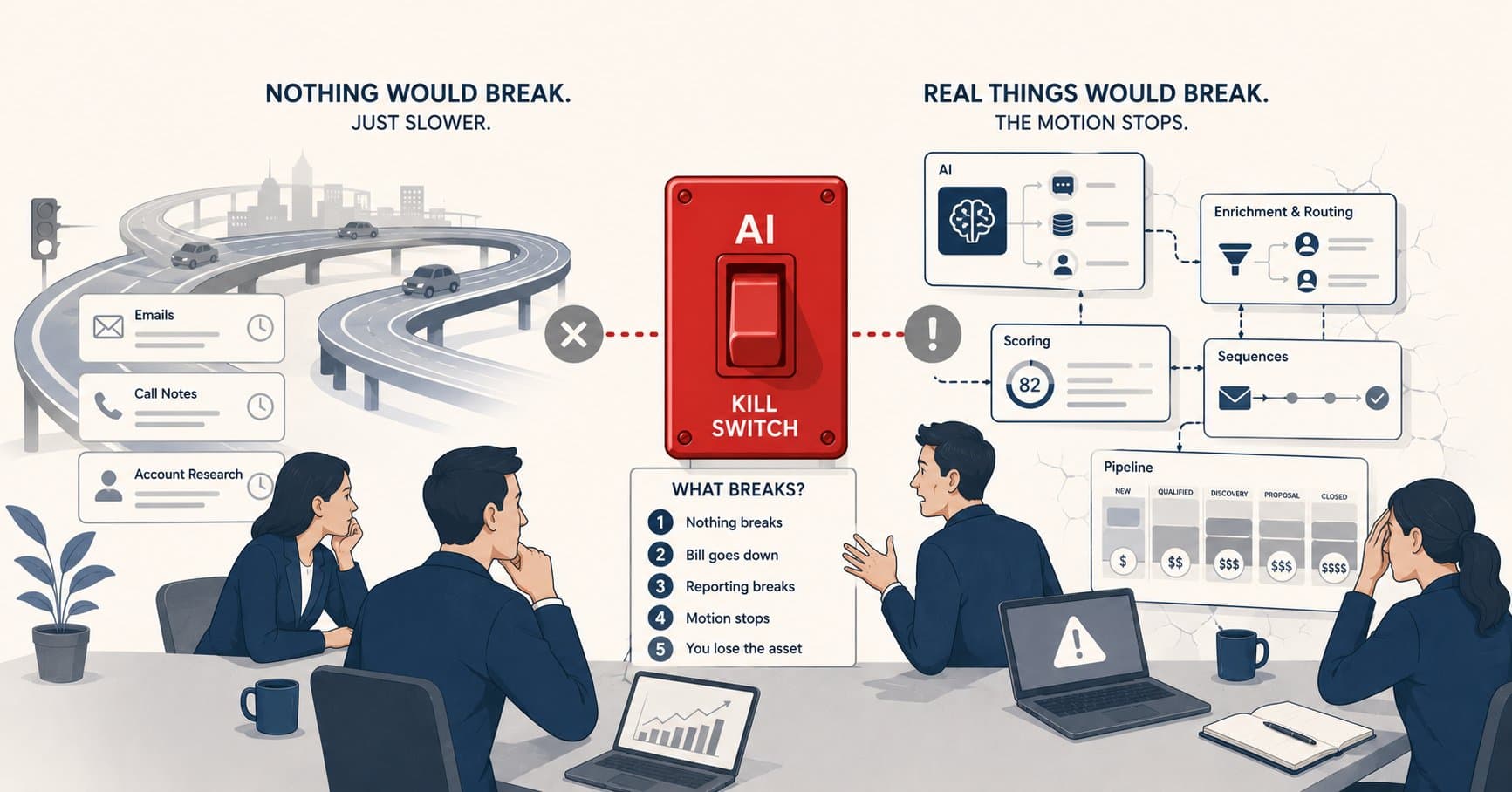
Ask your leadership team this in your next staff meeting: if we cancelled every AI contract tonight and pulled AI out of our go-to-market tomorrow, what would stop working? Not slow down. Stop.
Then watch how long the room takes to answer.
The question comes from Nate Nasralla, who wrote it up for OnlyCFO last week in a piece aimed at finance leaders sizing up their revenue org. It’s the fastest read on AI adoption I’ve come across this year. If real things break, you’ve built AI into the motion. If everything keeps humming along, just slower and more annoying, you’ve built what Nate calls a floating highway: hovercars from The Jetsons, driven down roads with stoplights and lanes because roads are what everyone already knew how to build.
For most revenue teams right now, the honest answer is “nothing would break.”
Nate is right that maturity assessments are theater
He takes a direct shot in the piece, and I want to give it its full weight before I disagree with any of it: “You can run all the ‘AI Maturity Assessments’ you’d like, but you really only need one question.”
He’s right about the ones I’ve seen. A scored grid arrives, twenty-two questions get answered by the person who owns the tools budget, and a number comes back. You’re a 2.7. The deck gets presented, everyone nods, and Monday looks exactly like Friday. The assessment measured what you’ve purchased and how many people have logged in, which is why it flatters you. Nate’s question can’t be gamed the same way, because it asks what would happen if you took the whole thing away, and nobody’s ego is attached to the answer.
So I’d start where he starts. Ask his question first.
In practice, there’s real difficulty in what comes next. His question is binary, and binary is exactly what you want from a diagnostic. But if your answer is “nothing would break,” you now know precisely one thing about your organization and have no idea what to do on Monday. You can’t go from a floating highway to an AI-native motion in a single move, and if you try, you’ll do what most teams do: buy something bigger and stay exactly where you are, on a wider road.
The question needs rungs.
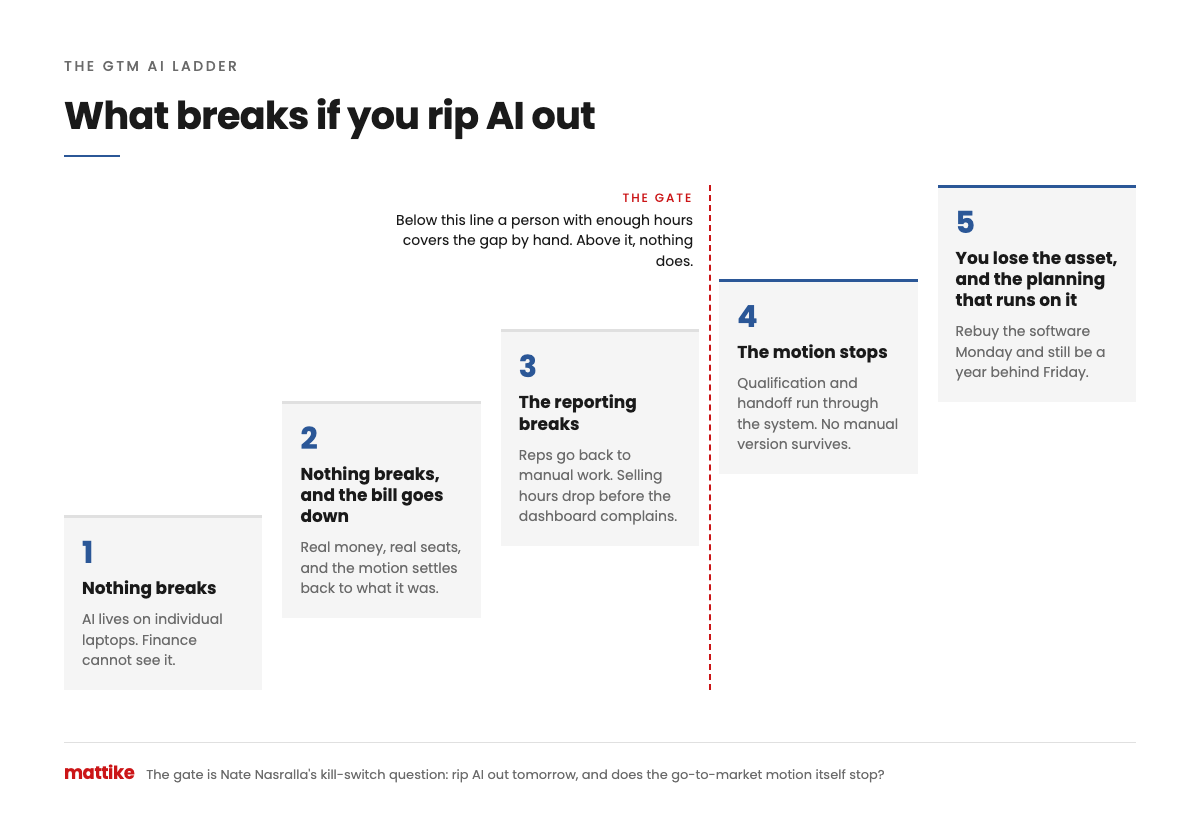
Five versions of “what breaks,” in order
Each rung is defined by what would break, and each carries its own test. Order matters, so read it as a sequence and take the last one you can honestly answer yes to.
-
Nothing breaks. A few people get slower at writing emails and cleaning up notes. AI is on individual laptops, expensed or free, invisible to finance. There’s real productivity happening and none of it compounds, because when the person leaves, so does the workflow they invented. The test: can anyone tell you what go-to-market spent on AI this month, and who approved it?
-
Nothing breaks, and the bill goes down. You’ve bought seats, a copilot, maybe an SDR agent. Actual money is moving. Pull it out and the motion continues. It may slow a little, or bend around the gap for a week while people adjust, and then it settles back to roughly what it was, minus the invoice. This is the floating highway, and it’s the most expensive place in the whole climb to be parked. The test: is there a real invoice, and would cancelling it be the only thing that changed?
-
The reporting breaks. AI is wired into your data. Call summaries write to the CRM, inbound gets enriched and routed, accounts get scored on something better than firmographics. Rip it out and your pipeline view goes dark while somebody rebuilds it by hand. This is also the first rung where your reps start complaining, and the complaint is the useful signal. They regress to logging calls, chasing down data, and researching accounts manually, so their non-selling hours climb week over week. The test: would your reps feel it before your dashboard did? Watch selling hours, and they’ll tell you well before the reporting gap gets escalated.
-
The motion stops. Qualification, handoff, and follow-up run through systems that don’t function without a model inside them. New hires ramp against something that rewrites itself weekly instead of a PDF playbook updated once a year at SKO. Pull AI and the process itself stops, because the process is the system. There’s no manual version waiting in a drawer either, since the manual version stopped existing about a year into the build. The test is Nate’s: rip AI out tomorrow, and does the go-to-market motion itself stop? If people would grind through with longer hours and keep selling, you’re still on three.
-
You lose the asset, and the planning that runs on it. The system has been accumulating something specific to you: which behaviors precede a won deal in your enterprise segment, what your strongest rep does in the hour after an exec meeting that your median rep doesn’t. By this rung the exec team is deciding on it. Capacity models, comp design, segment bets, and next year’s hiring plan all get set against what the system says, and those decisions come back in as new data the system learns from. Rip it out and you lose the accumulated record along with the basis for next quarter’s plan. The test: would planning fall back to intuition and last year’s numbers?
Nate’s question is the fourth test, and its position is the whole point. It’s the gate. Below it, things break and a person with enough hours can cover the gap by hand. At it and above, there’s no manual version left to fall back on. That’s the one line on the ladder that tells you which half you’re standing in, so ask his first and the others after. If you only have time for one more, use the rung three test, because reps are a faster instrument than a dashboard and they’ll tell you without being asked.
I haven’t met a team living on rung five yet, including some of the ones selling it. That’s fine. The point of the sequence is knowing which one move is yours.
The move that belongs to each rung
Knowing your rung is worth nothing on its own. It’s worth something if it narrows the work, so here’s the one thing I’d do from each position. Pick one. A rung is a structural change, and going after three at once is how you end up back on two with a bigger invoice.
On rung one, count it. One person, one spreadsheet, every AI charge across go-to-market this month, including the free tiers nobody thought to mention. You’re not building a governance program, you’re finding the number. Until it exists, you’ll keep buying against a total no one has ever seen.
On rung two, pick one motion and wire it into the data. Inbound routing is usually the easiest place to start, because it’s self-contained and the result shows up inside a week. The bar is specific: when you’re done, a report somebody actually reads should break if you switch the model off. That’s the whole test, and it’s how you leave rung two, one motion at a time.
On rung three, take your worst handoff out of the document and put it in the system. You have one, and your reps will name it in about four seconds if you ask them. Rebuild it so it can’t run manually. That sounds reckless and it’s the point, because as long as a manual path exists people fall back to it under pressure and the system never becomes load-bearing.
On rung four, start paying for judgment. Nate’s SPIF, run against your two or three strongest reps. Trace what they do that your median rep doesn’t, and attach money to them contributing it. This is the slowest move on the list and the only one that’s mostly a comp conversation rather than a build.
On rung five, put the output in front of the people who decide. What the system reads about your segments goes into the capacity model, the comp design, next year’s coverage plan, and whatever you’re about to tell the board. Then what those decisions produce comes back in as data. If nothing about your planning changes because of what the system learned, you’re on four wearing a five.
The rung that costs the most is the second one
I keep meeting revenue leaders somewhere past their first big AI budget and quietly deflated about it. The spend is real, the pilots ran, a few people liked the tool, and nothing in the numbers moved. The instinct is to read that as “we’re partway there.” You’re not partway. Rung two is a different structure, and the climb out usually starts by backing away from some of what you already bought.
Nate’s Bedrock example makes the same point from the finance seat. In his illustration, a $100M software business watches CAC fall from $47K to $36K after a year of AI rollouts, and the board celebrates efficiency. Break it out by segment and the gain evaporates: the mix simply shifted toward SMB, where CAC is structurally lower. The gauge said one thing. The machine was doing another.
Where this gets tricky is that everyone’s dashboard has some version of that gauge on it. Pipeline coverage, cost per lead, and activity per rep were built for a world where effort was scarce and roughly equal to results. Activity is now close to free and functionally infinite, so a rep tripling their outbound volume tells you almost nothing about whether they’ll close anything. Your first move up from rung two is finding out which of your gauges is measuring a machine you no longer run. A better tool comes later, if it comes at all.
What sits at the top is your reps’ judgment, written down
What makes rung five worth the climb is what the system has been recording while you ran it.
Your best rep operates on a set of reads nobody has ever written down. Nate has a good one: the procurement intro that lands at 8:30 on a Friday night means something completely different from the same intro arriving Wednesday at 10am, and a strong rep will price and negotiate differently because of it. That read is worth real money and it lives in one person’s head. When they leave, it leaves.
His proposal for fixing that is the sharpest operational idea in his piece, and it’s a comp idea. Trace the behaviors of your top performers, then pay them for contributing that training data back into a model that guides everyone else. A SPIF for building an asset that appreciates, instead of a bonus for a number they were going to hit anyway.
I’ve watched a version of this work. The AI-first onboarding and training flow I built for a sales team tested knowledge, assigned modules, and coached people forward, and the automation turned out to be the least interesting part. What made it worth building was that the reasoning of the people who were already good got written down and became reusable. That’s rung four heading toward five, and it is genuinely slow to build. The system has to be fed by people who have every incentive to keep working in the dark, which is exactly why the comp question matters more than the software question.
The loop only closes when what the system learns reaches the planning table. If a pattern surfaces about your enterprise segment and nothing about your capacity model changes because of it, you’ve built an expensive reporting layer and stopped a rung short.
Turn it into one number in FY27 planning
If you want a single place to put this to work, Nate hands it to you, and planning season is right now.
When you build next year’s capacity model, force the split: what percentage of added sales capacity do we expect to come from new headcount, and what percentage from what Nate calls “system leverage”? Then compare that split to last year’s.
That one comparison does more than any assessment score. It’s specific, it’s a number a CFO will accept, it forces RevOps and Enablement to own a piece of the revenue outcome rather than a ticket queue, and you can check it against reality twelve months later. If the split hasn’t moved at all while your AI spend has gone up, you have your answer about which rung you’re on, and you didn’t need a survey to get it.
Where I could be wrong about this
The objection I take most seriously is Nate’s own, turned back on me. A ladder can become the exact ritual he was warning about. If your team’s takeaway is “we’re a rung three” and a slide gets made, the sequence has failed the same way the assessments failed. The only defense is that every rung here is defined by something that would visibly break, which makes it a question for whoever maintains your systems. Ask an engineer, not a vendor. I could be convinced of the counter argument.
The point
Ask Nate’s question first, because it’s the cheapest honest read on where you actually stand. Expect the answer to be “nothing would break,” because for most teams it is. Then treat that answer as a starting position instead of a verdict. Find your rung, take the one move that belongs to it, and leave the other four alone until that one is finished.
The teams still on the floating highway will keep treating AI as a line item to defend to the board, and they’ll get exactly what they measure. Somewhere below all of this is an older idea that keeps proving itself: a tool applied to a broken process gives you a faster broken process. The kill-switch question is just the fastest way anyone has found to make that visible in a room full of people who’d rather not look.
Frequently Asked Questions
What is the kill-switch question for AI adoption?
If you cancelled every AI contract and pulled AI out tomorrow, what would stop working? Not slow down—stop. The answer reveals your actual integration maturity versus perceived readiness.
What are the five rungs of AI maturity?
Rung 1: Nothing breaks (invisible individual use). Rung 2: Floating highway (paid tools, easily reversible). Rung 3: Reporting breaks (AI wired into data systems). Rung 4: Motion stops (process-dependent systems). Rung 5: Planning collapses (strategic decision-making dependent).
Why is rung four the critical gate?
Below rung four, manual workarounds exist—people can cover gaps with extra hours. At rung four and above, no manual version exists. This line separates reversible adoption from structural dependency.
What is the one move for each rung?
Rung 1: Count all spending. Rung 2: Wire one motion into data (start with inbound routing). Rung 3: Rebuild worst handoff systemically. Rung 4: Pay for judgment via SPIF. Rung 5: Integrate system output into planning.
Why is rung two the most expensive place to park?
Large invoices with zero structural dependency. Cancelling service barely disrupts operations—the money spent produces convenience, not integration, making it easy to stay trapped without progressing upward.