Reps Still Spend 30% of Their Time Selling. AI Didn't Move That Number.
Most AI rollouts didn't take admin work off the rep — they layered new surfaces on top of the old ones. Until you cut what's underneath, every tool you add is a productivity story for the vendor, not for the seller.
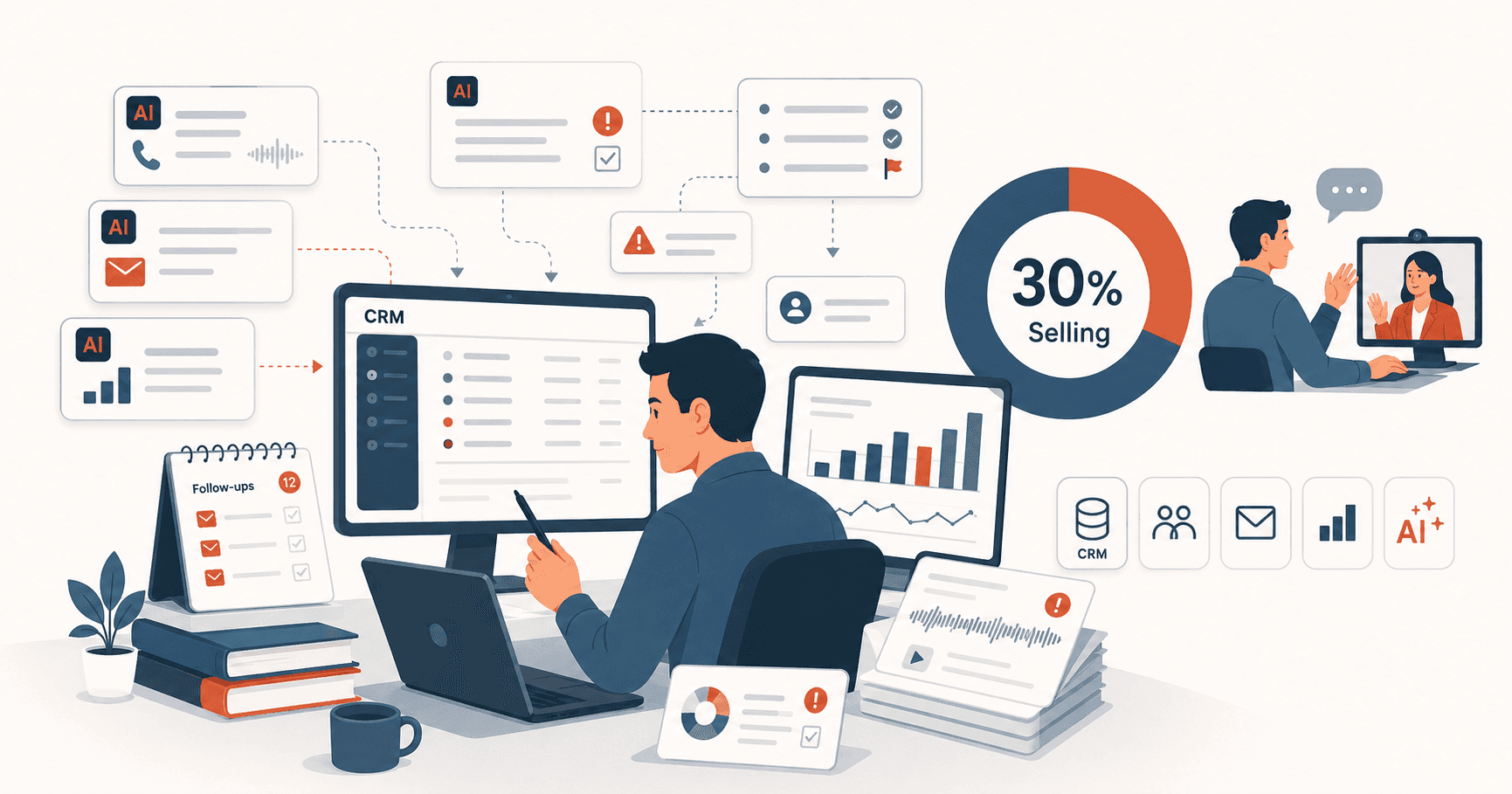
Most AI rollouts didn't take admin work off the rep — they layered new surfaces on top of the old ones. Until you cut what's underneath, every tool you add is a productivity story for the vendor, not for the seller.
Sales reps spend less than a third of their week on selling work. The AI cycle was supposed to fix that. The 2026 productivity numbers are in, and the band hasn't moved.
It still sits between 28% and 32%, the same range it's held for more than a decade. Internal meetings, CRM updates, prep, research, handoffs, and reporting eat the rest. Every previous wave of sales technology was sold as the fix. None of them moved the band. AI was supposed to be different. So far, it's behaving exactly like the waves before it.
Most of the leaders I work with have an explanation for this. Most of them are diagnosing the wrong cause.
The Number That Won't Move
CRM was supposed to replace the spreadsheet that ate Tuesdays. Sales engagement platforms were supposed to replace the manual cadence work. Conversation intelligence was supposed to replace the manual call-review meetings. Each generation of tools made the surface easier to operate. The total surface area never shrank.
AI was pitched as a structural break from that pattern. The promise wasn't faster execution of the existing work. The promise was the removal of entire categories of work. An LLM doesn't make CRM data entry easier; it does the entry. An AI note-taker doesn't help you write the recap; it writes it. If the promise had landed, the 28-32% band should be moving by now.
It hasn't.
What Actually Happened
In practice, there's real difficulty in handing rep time back through automation. Your AI tools didn't take the workflow away. They added a verification layer on top of it. Your reps now read the AI-drafted email and decide whether to send it. They read the AI-generated CRM summary and correct the parts that are wrong. They review the auto-generated meeting notes and re-tag the action items. None of that review work existed two years ago. The old work didn't go away. The review work showed up on top of it.
That's the mechanism most leaders aren't naming clearly. AI translates work into review tasks. Review tasks are still the rep's time.
The pattern gets worse when you stack tools. Most teams don't have one AI surface. They have four or five running at once. An AI SDR drafting outreach. An AI note-taker in calls. An AI agent updating CRM. An AI forecasting layer reading the deal data. Each one is individually good. Together they produce a meta-job: the rep is now the editor of four systems whose outputs disagree with each other, and reconciling them is its own unbilled task.
Do:
- Audit where rep time actually goes today. AI usage is a vendor metric, not a productivity one.
- Ask your reps directly which AI tools save them time and which add a step. Their answers usually surprise the leadership team.
- Track selling time on the calendar, not adoption rates on the dashboard.
- Treat any AI rollout that doesn't measurably reduce a rep task as a productivity miss, even when usage is high.
Don't:
- Conflate AI tool usage with rep productivity. One is a vendor's metric. The other is yours.
- Assume your reps will tell you the rollout isn't working. Most of them will work around it quietly.
- Take credit for reclaimed time you can't measure on the rep's calendar.
A Week Inside the Number
Picture a mid-market AE running 25 active deals.
Before AI, that AE wrote one weekly forecast, updated CRM after each meaningful call, and sent follow-ups manually. Repetitive, time-consuming, and exactly the kind of work a tool should help with. Roughly 30% of their week went to selling.
After the AI rollout, that same AE receives an AI-drafted forecast they have to validate against their own gut, an AI-drafted CRM summary they need to correct because the call transcript misheard a procurement concern, AI-generated follow-ups that need a tone check before sending, and an AI-flagged risk alert that, when investigated, turns out to be the model misreading a stalled email thread.
Each one of those interactions takes five to fifteen minutes. The AE used to do the underlying work in roughly 90 minutes. The review pass over four AI outputs runs closer to two hours. The work feels lighter. None of it had to be written from scratch. The clock didn't move. In several cases I've seen, the clock got worse. The rep is still at 30%.
The Counter-Argument I Keep Hearing
Some leaders push back here, and the pushback has merit. AI-assisted SDRs are booking 30-50% more meetings than reps using manual approaches. Hybrid AI-plus-human pods are generating $278K of pipeline per seat per month versus $187K for pure-human configurations. The AI productivity story isn't fake. Something is working.
What's working is throughput at the top of the funnel. AI is shrinking the cost per meeting booked, the cost per outbound touch, and the cost per researched account. Those wins are real and worth having. None of them touch the 30% number. The 30% number measures how much of a rep's week goes into substantive customer work — discovery, demo, negotiation, close. Throughput at the top of the funnel doesn't free that time. It tends to consume more of it, because more meetings booked means more meetings to prep for and run.
I could be convinced of the counter-argument if the 28-32% band actually moved. So far, the volume metrics moved. The substance metric didn't.
What Actually Frees Rep Time
The hard truth is the one most teams skip: you cannot automate your way to more selling time if the underlying process is the thing eating the week. AI on top of a bloated process produces a faster, prettier, more intelligent version of the same bloat. The fix has to come before the layer.
A few practical moves are worth running before you add another AI tool. None of them are AI moves. They're process moves that earn the AI moves their place.
Do:
- Cut what doesn't need to be tracked. Most CRM hygiene rules are artifacts of a forecast process nobody runs anymore. Pick the fields you'll stop populating and stop reporting on the ones you cut.
- Kill the meetings AI can replace, not just the tasks inside them. If your AI summarizes your sales standup, the standup is the thing to cut.
- Consolidate the reporting cadence. When your CRO asks for the same pipeline view three different ways, your RevOps team rebuilds it three different ways, and that work flows downstream to the rep. Pick the view. Retire the others.
- Set a clear AI-output threshold. Decide which outputs need human eyes and which the AI is allowed to ship.
Don't:
- Add a new AI tool without first removing the process step it's supposed to replace.
- Default to "review everything." That's where the new admin layer lives.
- Measure rollout success by how many reps adopted the tool. Measure it by whether selling time actually moved.
The 30% Number Is the Truth-Teller
There's a version of the AI productivity conversation that's about tools, and a version that's about discipline. The tools version is the one most teams are running. Buy the AI SDR. Buy the AI forecasting agent. Buy the AI note-taker. Watch the demo charts go up and to the right. Watch the rep's calendar look about the same as it did last year.
The discipline version is harder, slower, and the only one that moves the band. It starts with cutting the process before layering the tool, and it ends with a rep whose week actually looks different.
The 30% number is the truth-teller for which version you're running. Until it moves, the productivity gain you are seeing belongs to the tool, the demo deck, or the vendor — not to the seller. Worth having. Not the thing the original promise was about.
If your reps still aren't selling, the AI isn't the problem. The work underneath it is.
Frequently Asked Questions
Why haven't AI tools increased the percentage of time reps spend selling?
AI tools add verification layers on top of existing workflows rather than removing tasks. Reps now review AI outputs—drafts, summaries, notes—creating new admin work that didn't exist before.
What percentage of time do sales reps actually spend selling?
Between 28% and 32% of their week. The remaining time goes to meetings, CRM updates, prep, research, handoffs, and reporting. This ratio hasn't changed in over a decade.
How should leaders measure AI rollout success?
Track actual selling time on rep calendars, not adoption rates. Ask reps which tools save time versus add steps. Measure whether the rollout measurably reduces a rep task, not just usage metrics.
What needs to happen before implementing more AI tools?
Cut the underlying process first. Remove unnecessary CRM fields, eliminate meetings AI can replace, consolidate reporting, and decide which AI outputs need human review before adding new tools.
Why is AI throughput increasing if selling time hasn't improved?
AI boosts top-of-funnel metrics like cost per meeting booked, but more meetings mean more prep and execution work. Throughput gains consume the time they were supposed to free.