The First Thing We Build for a New Client Isn't a Workflow
Before the automation, before the agent, we spend a couple of hours building a voice profile. It feels like a detour when the client wants the shiny thing. It's the foundation every AI system after it sits on top of.
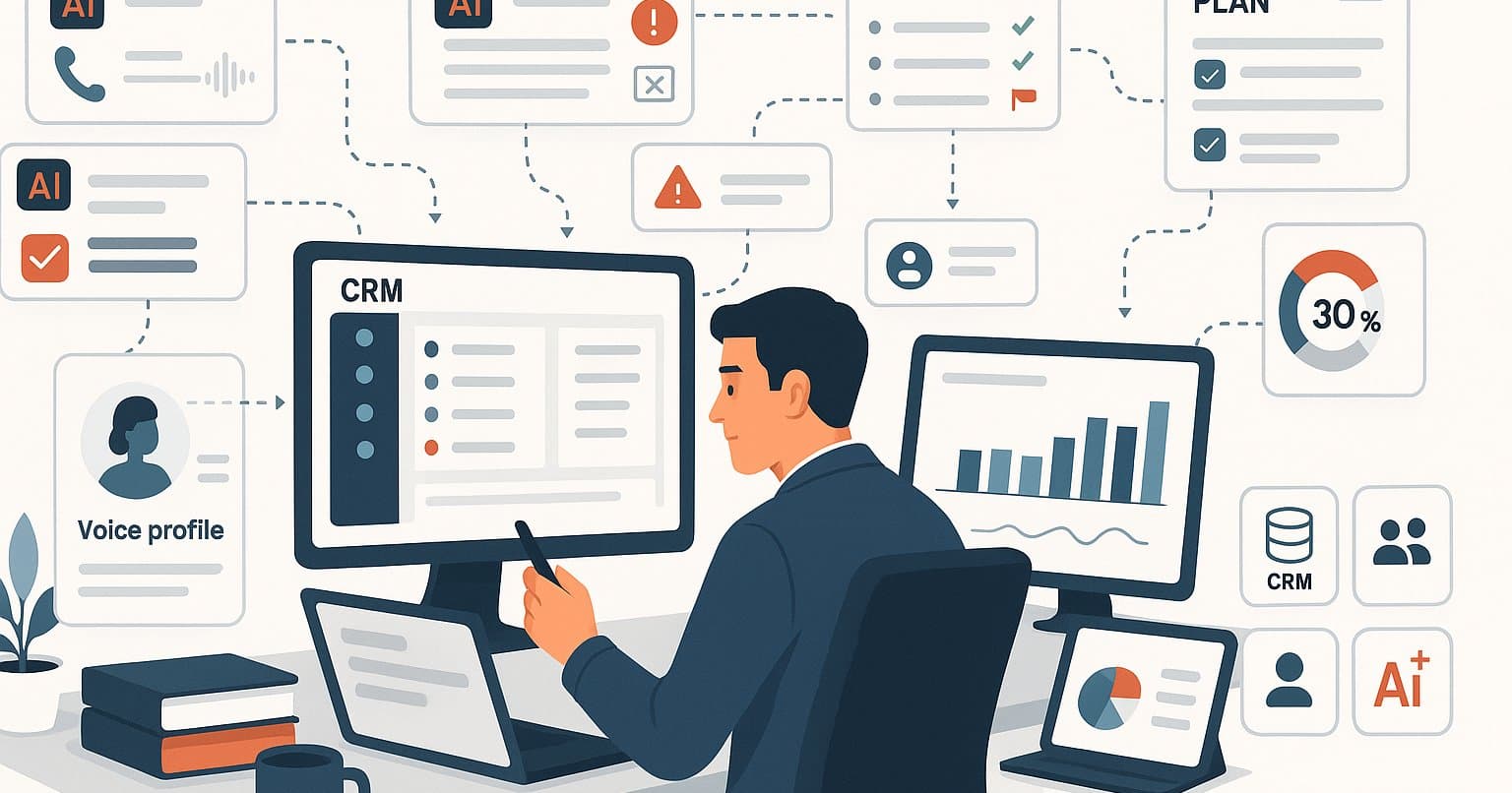
Before we automate anything for a new client, we sit down and build a voice profile. A couple of hours of questions before a single agent gets stood up. Clients almost always want to skip it and get to the automation. The ones who invest the time end up with AI that people actually use.
Here’s the trap most teams walk into. You buy the tools, you wire up the workflow, the demo looks great, and then three weeks later nobody’s touching it. Not because the automation broke. Because the output didn’t sound like the person it was supposed to be helping, so they quietly went back to writing everything themselves. The system worked. The adoption didn’t.
Every AI system you build sits on top of people. How they talk, how they decide, what they’d never say out loud to a customer, how they handle a disagreement, where they push and where they hold back. If the AI doesn’t have that, it defaults to the average of everything it has ever read. Average is generic, and generic is exactly what an experienced operator reads in half a second and rejects.
In practice, there’s real difficulty in getting an AI tool adopted inside a team that already knows what good looks like. Your best rep reads a drafted follow-up, feels it’s a little off, and can’t quite say why. So they rewrite it. Then they rewrite the next one. Within a month the tool you paid for is a slower way to get to the same email they’d have written anyway. The gap was never the model. It was that nobody taught the model who it was writing as.
A voice profile closes that gap. It captures the things a prompt written on the fly never does: the beliefs a person leads with, the words they reach for on purpose, the phrases that make them cringe, the way they signal they’re not fully sure yet. It captures the messy edges too. Real people don’t talk in round numbers or tidy three-part structures, and the profile keeps that texture instead of sanding it off.
This is the same principle I hammer on with data. If you point AI at a weak foundation, it doesn’t fix the weakness, it amplifies it. Point it at your writing without ever defining how you write, and it will confidently produce a version of you that isn’t you, at scale. The couple of hours up front is the foundation. Skip it and every downstream thing you build inherits the gap.
You could argue this is over-engineering. Just prompt the thing each time and tell it what you want. And for a one-off, sure. But if you’re building AI into how a team actually operates, you’d be re-teaching the same context every session, hoping you remember to include the right details, getting slightly different results each time. One of my load-bearing rules is that I don’t do a process twice if I can help it. A voice profile is that rule applied to voice: define it once, reference it everywhere, from the email drafts to the proposals to the agents that run while you sleep.
The payoff is that it compounds. Once the profile exists, every system after it reads from the same source of truth. The onboarding agent sounds like the founder. The follow-up drafts sound like the rep who owns the account. Consistency stops being something you enforce by editing everything, and starts being something the foundation just carries.
If you want to feel the difference, build one on yourself before you build one for your team. We put a shortened version of the interview we use with clients online, about five minutes, so you can get started on your own writing at mattike.com/voice. It emails you a summary, plus a larger prompt you can take further whenever you’re ready to go deeper. Give it the honest five minutes. It’s the cheapest, highest-return thing you can do before you let AI write a single word in your name.
The best AI system in the world still has to sound like the person it’s standing in for. That part isn’t the model’s job to guess. It’s yours to define first.
Frequently Asked Questions
Why should we build a voice profile before automating?
Voice profiles capture how people actually write—beliefs, word choices, hesitations, texture. Without it, AI defaults to generic output that experienced teams reject.
What happens if we skip the voice profile and go straight to workflows?
Teams quietly abandon the tool because outputs don't sound right. They rewrite everything anyway, making AI slower than their original process.
How long does it take to build a voice profile?
A couple of hours of questions upfront. It compounds across every AI system you build after, eliminating repetitive context-setting in each session.
Can't we just use better prompts instead?
One-off prompts require re-teaching context every session and produce inconsistent results. A defined voice profile becomes a single source of truth for all systems.
Does voice profile building apply to teams or just individuals?
Both. Individual profiles ensure personal writing consistency; team profiles ensure agents and drafts sound authentic to whoever they represent.