When Your Team Can Build Faster Than You Can Plan
AI is collapsing the time between idea and working version. When building gets faster than planning, the quarterly cycle stops being a strategy tool and starts being the slowest part of the company.
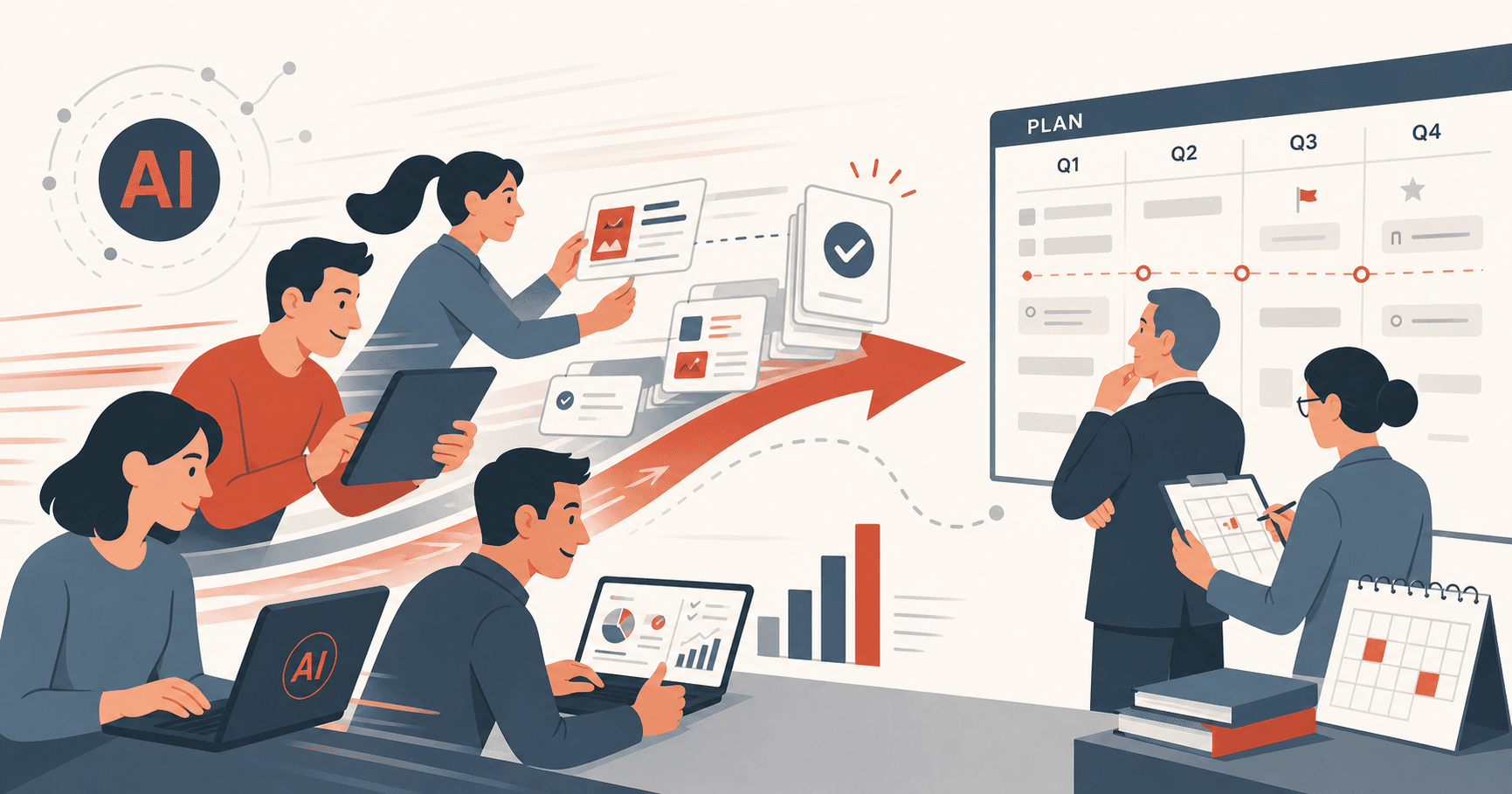
AI is collapsing the time between idea and working version. When building gets faster than planning, the quarterly cycle stops being a strategy tool and starts being the slowest part of the company.
The cost of execution used to justify everything about how companies plan. Long cycles, heavy documentation, executive alignment sessions, phased rollouts, all of it existed because building something wrong was expensive and slow to undo. AI is collapsing that cost faster than most organizations have noticed. And when execution gets fast enough, a question starts to form that most leadership teams haven't confronted yet: what happens when your people can build and iterate faster than your planning process can keep up with?
I'm working on this idea. It started as a pattern I kept seeing across client conversations and sharpened into something worth putting in front of other people who are noticing the same thing. The hypothesis isn't fully baked, but the pattern is consistent enough to name.
Why Quarterly Planning Existed
For most of the last few decades, the math was straightforward. Ideas were cheap. Execution was expensive. You could sketch a hundred ideas on a whiteboard in an afternoon, but turning any one of them into something real took weeks or months of coordinated effort. Engineering time. Design cycles. Vendor procurement. QA. All of it added up. That gap between having the idea and proving it works is what made planning valuable. You couldn't afford to build the wrong thing, so you invested heavily in making sure you picked the right thing before anyone started building.
Quarterly planning sessions grew out of that math. Leadership meets, reviews priorities, allocates resources, and produces a roadmap. Teams execute against the roadmap for 90 days. At the end of the quarter, everyone reviews what shipped and what didn't, and the cycle resets. The cadence makes sense when execution is the bottleneck, when the most expensive mistake you can make is building something for three months and learning in month four that it was the wrong bet.
Planning was never the goal. It was a workaround for slow, expensive execution.
The Math Is Changing
AI is compressing the distance between idea and working version. A workflow that would have taken a team two sprints to scope and build can be prototyped in a weekend. A campaign strategy that needed a writer, an editor, and a designer for three weeks can be drafted, tested, and revised in a fraction of that. The specifics vary by team and domain, but the direction is consistent: the time and cost to go from "what if we tried this" to "here's a working version, let's see if it holds up" is shrinking fast.
When that happens, the traditional justification for long planning cycles starts to thin. If building the wrong thing costs you a week instead of a quarter, the risk equation shifts. You don't need to be as certain before you start. You can build a version, test it, learn from it, and iterate, and the total time for that loop may be shorter than the planning session that was supposed to prevent the bad build in the first place.
This is the part that's easy to say out loud and hard to internalize. Most leaders I work with will agree that AI makes teams faster. Then they walk into their next quarterly planning session and run the same process they've run for five years. The speed change gets acknowledged in the abstract and ignored in practice.
The Room Your Builders Aren't In
Here's where the pattern gets interesting. Quarterly planning in most organizations isn't just a cadence. It's a power structure. Strategy gets set at the top, in a room that builders aren't in. The output is a deck or a set of OKRs that flows downward. Teams receive the plan and execute against it. Feedback flows upward at the end of the cycle, if it flows at all.
That structure assumed execution was the constraint. Leadership's job was to think carefully so the team's time wasn't wasted on the wrong work. Reasonable assumption when building was slow.
But when execution speed passes planning speed, the question shifts. It goes from "can we build this?" to "can leadership generate clear direction fast enough for a team that's ready to move right now?"
In practice, there's real difficulty in confronting that shift. Your executive team built their careers in a world where careful upfront planning was the highest-value activity a leader could do. The instinct to plan more before building is baked in, and it was the right instinct for 20 years. Rewiring it means accepting that the skill that made them successful may not be the one the organization needs most from them going forward. Changing a process is the easy part. Changing how a leader sees their own value is a different conversation entirely.
Vision as the Product
If planning was a workaround for slow execution, and execution isn't slow anymore, then leadership's value has to come from somewhere else. I keep landing on the same answer: leadership's primary product becomes vision clarity and outcome definition.
Direction over blueprints. When your team can build and iterate in days, what they need from you isn't a detailed spec or a sequenced roadmap. They need to know where you're pointed and how you'll measure whether you've arrived. Clear vision. Measurable outcomes. A framework for prioritizing what's worth pursuing next, not a predetermined list of exactly what to build and when.
The discipline doesn't go away. It moves upstream. Instead of "what exactly should we build and in what order over the next 90 days," leadership invests in "what does success look like, and what guardrails does the team need to iterate toward it?" The planning sessions get shorter. The check-in cadence gets faster. The team's authority to solve problems in real time goes up.
There's a version of this that works and a version that turns into chaos. The difference is the quality of the outcome targets. Vague outcomes with fast execution produce a lot of activity that doesn't add up to anything. Specific, measurable outcomes with fast execution produce rapid convergence. A team told to "improve the customer experience" will build 14 things in a month and none of them will connect. A team told to "reduce time-to-first-value by 30% for mid-market accounts" will build three things, throw two away, and ship one that matters.
Speed collapses the wait. The thinking moves upstream.
The Wall You Haven't Hit Yet
Most organizations haven't hit this wall yet. The current wave of AI adoption is still focused on making existing workflows faster, same plan, same cadence, less manual effort per task. That's the comfortable phase. The harder phase comes when the speed improvement is large enough that the planning cycle itself becomes the slowest-moving part of the company, and the leadership team has to reckon with the fact that their quarterly rhythm is the governor on the engine.
I don't think that reckoning is years away. For some teams, it's already here. Every improvement in AI capability further compresses the execution timeline, and at some point the gap between "how fast we can build" and "how fast we can decide what to build" becomes impossible to ignore.
The companies that figure this out early won't be the ones with the best AI tools. They'll be the ones willing to rethink what leadership owes the team when the team can move faster than the plan above them. That's a harder problem than AI adoption. It's a question about what executive leadership is actually for when the barrier to execute is no longer the barrier that matters.
Frequently Asked Questions
Why is quarterly planning becoming obsolete?
Quarterly planning existed because execution was expensive and slow. AI compresses idea-to-working-version timelines from months to days, making lengthy planning cycles the slowest part of the organization.
What should leaders do instead of traditional quarterly planning?
Focus on vision clarity and outcome definition rather than detailed specs. Leaders should set measurable targets and guardrails, then let fast-moving teams iterate toward results in real time.
How does faster execution change a leader's role?
Leadership value shifts from careful upfront planning to defining clear outcomes and frameworks for prioritization. The discipline moves upstream; planning sessions shorten while check-in cadence accelerates.
What's the difference between vague and specific outcomes at speed?
Vague outcomes with fast execution create scattered activity. Specific, measurable outcomes enable rapid convergence. A 30% time-to-value goal produces focused shipping; generic improvement requests produce chaos.
When will organizations hit this planning wall?
Some teams already have. As AI capability improves, the gap between build speed and decision speed becomes impossible to ignore. Early adopters will rethink what executive leadership delivers to fast-moving teams.