Stop Guessing: Use AI to Evaluate Pipeline Quality at Scale
Stop relying on gut—use AI to score pipeline quality at scale. Define what “good” looks like, generate AI deal health scores, make reviews action-oriented, and retrain the model with wins and losses.
SALES LEADERSHIPSALESGO-TO-MARKETAIREVOPS
Matt Edwards
1/6/20264 min read
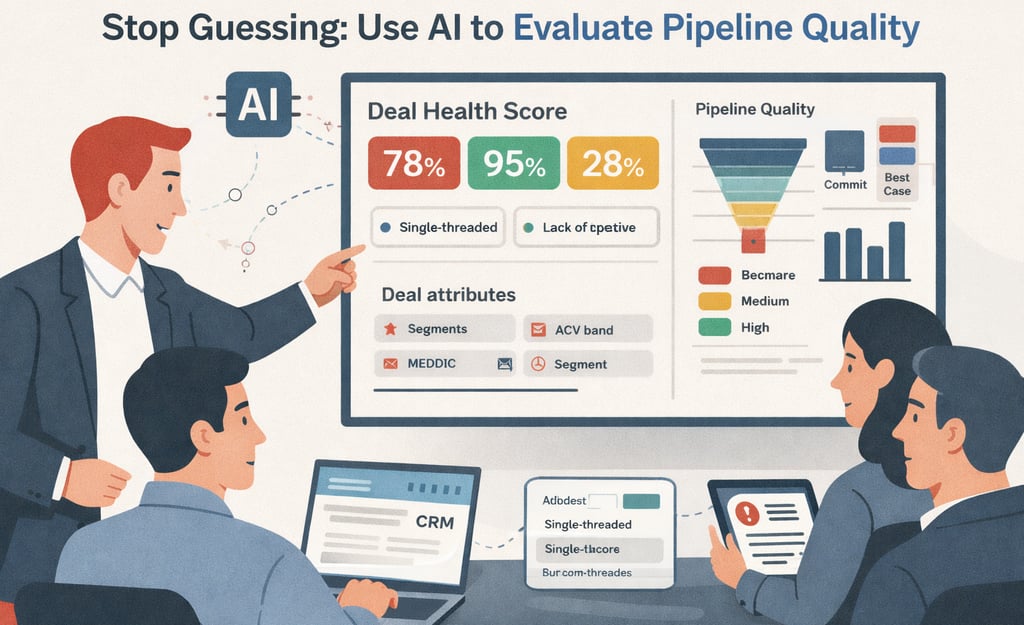
Most teams don’t have a pipeline problem. They have a pipeline quality problem.
Every Monday, VPs of Sales sit through the same ritual: reps walk through deals, everyone debates “commit vs best case,” and you leave with a forecast that’s based more on gut than data. Then the quarter ends, and you’re surprised again.
If you’re running a modern SaaS sales org and you’re not using AI to evaluate pipeline quality, you’re choosing opinion over evidence.
Here’s how to use AI to score pipeline quality at scale—and how to bake it into your regular deal reviews and pipeline cadences so it actually sticks.
Step 1: Define What “Good Pipeline” Means in Your World
AI is not magic. If you feed it noise, it’ll scale the noise.
Before tools, define what high-quality pipeline looks like based on your own closed-won data:
Deal attributes: segment, ACV band, product mix, region
Process attributes: # of stakeholders engaged, time in stage, # of meetings, MEDDIC completeness
Engagement attributes: email replies, meetings set, mutual action plan in place, exec sponsor identified
Risk flags: single-threaded, stuck in legal/security, heavy discounting, long gaps in activity
Your goal: translate this into a simple, explicit definition of a high-quality opportunity, such as:
“Opportunities over $30k, in stage 3+, with at least 3 engaged contacts, a documented pain and quantified impact, a next meeting on calendar, and time-in-stage under 30 days.”
This is the pattern you’ll train AI to recognize and score.
Step 2: Use AI to Create a Deal Health Score for Every Opportunity
Once you know what “good” looks like, AI can score every deal in your CRM, daily, without a manager reading a single call note.
You want an AI-driven Deal Health Score that pulls from:
CRM fields: stage, age, value, segment, role titles, close date
Activity data: meetings, emails, replies, gaps in activity
Conversation data: call transcripts, notes, MEDDIC fields, custom fields
Then apply AI to:
Classify risk signals
No economic buyer mentioned
No clear go-live date or compelling event
No quantified impact or business case
Stalled next steps (“They’re thinking about it”)
Score each deal
0–100 health score, or simple tiers (High / Medium / Low)
With reason codes: “No exec sponsor,” “No next meeting,” “Single-threaded,” etc.
Roll up to pipeline quality views
% of this quarter’s pipeline that is “High health”
Health-weighted pipeline coverage (not just raw coverage)
Health trend week over week
This is how you transform “I feel good about the quarter” into “We have 1.6x health-weighted coverage with 61% of pipeline in High health.”
Step 3: Bake AI Insights into Your Weekly Deal Reviews
If AI scores deals but your managers still run deal reviews like it’s 2015, nothing changes.
You need to force AI into the conversation. For every 1:1 or team deal review, standardize the flow:
Sort by AI Deal Health, not by deal size or stage
Start with High value, Low health deals
Next, Medium health deals that can be pushed into High with 1–2 actions
Use the AI reason codes as the agenda
For each risky deal, ask:
“AI says there’s no economic buyer identified. Who signs this, and have we met them?”
“AI flagged ‘no clear next step.’ What’s the next meeting, what’s the mutual action plan?”
“AI marked this as single-threaded. Who else do we need in the deal this week?”
End each review with 2–3 concrete actions per deal
Add an exec sponsor meeting
Send ROI summary and ask to review with finance/CFO
Book a technical validation call
These actions should be written in CRM, not just said aloud.
If AI insights aren’t shaping the questions you ask in deal reviews, you aren’t using AI—you’re just looking at a fancier dashboard.
Step 4: Make Pipeline Reviews About Quality, Not Just Quantity
Most pipeline reviews still obsess over coverage ratios (3–4x pipe vs quota). That’s table stakes.
Use AI to make pipeline reviews about quality composition, every single week:
Health coverage:
“We have 3.2x coverage, but only 1.4x in High health. That’s the problem.”
Stage slippage and stalling:
“18% of pipeline has been in the same stage for 30+ days. AI flags most of these as ‘no business case.’”
Conversion odds by segment:
“Mid-market deals with exec sponsor identified convert at 32%. Enterprise deals without one convert at 4%. That’s where to focus.”
Your weekly pipeline meeting should answer:
“Do we have enough pipeline we can actually win, given how these deals look today?”
If the answer is “no,” you leave with specific prospecting motions, enablement tasks, and exec interventions, not just optimism.
Step 5: Close the Loop—Train AI with Your Wins and Losses
The point is not to have a static AI score. The point is to continuously improve your definition of quality.
Every month or quarter:
Compare AI health scores vs. reality
Win rate by health tier
Average cycle time by health tier
Over- and under-predicted deals (where AI was way off)
Update your quality definition
Add new signals that correlate with wins (e.g., security review started early)
Demote signals that don’t matter (e.g., some “must-have” fields that don’t move the needle)
Feed new patterns back into your AI model
This is where RevOps, Sales, and your AI/revenue tech partner must align.
The longer you do this, the more your AI becomes a living representation of your best pattern recognition, not just a generic score someone sold you.
The Bottom Line
If your pipeline and forecast still rely mostly on human intuition, you’re flying blind in a market where your competitors are not.
AI doesn’t replace judgment. It sharpens it:
It forces discipline around what “good pipeline” actually means.
It surfaces risk at scale, across thousands of deals, every day.
It turns deal reviews from storytelling sessions into action planning.
It makes pipeline reviews about quality and winnability, not just volume.
If you’re a VP of Sales, your next move is simple:
Define your own “high-quality opportunity” using past wins.
Stand up a basic AI-driven Deal Health Score in your CRM.
Rewrite your deal review and pipeline meeting agendas to be AI-first, action-first.
Then stop being surprised at the end of the quarter.